
How Octopus Energy Services Built a 96.5% Electric Fleet of 2,400+ Vans
At a glance: Gone are the days of rigid fleet management
When you are managing a massive commercial fleet, executing a commercial EV transition can feel like an impossible task. This case study looks at how Octopus Energy Services successfully tackled the challenge - removing their administrative headaches and conquering driver range anxiety by switching to a modern, unified platform. Here is how they did it:
The Problem: OES was drowning in mixed-fleet complexity, juggling separate fuel cards for petrol/diesel vehicles alongside multiple clunky apps for EV public charging.
The Octopus Fleet Fix: They consolidated everything. Drivers got one-tap access to 1.4 million+ chargers on the Electroverse, while the business eliminated manual expense forms overnight through automated Home Reimbursement.
The Big Win: By bringing their energy tracking, vehicle charging, and everyday travel expenses under one holistic dashboard, OES transformed their fleet operations into something super simple.
Want the full breakdown? Let’s get into it 👇

Introduction
Octopus Energy Services (OES) is leading the transformation of the energy industry. But how are they rapidly scaling the green workforce? Answer: They’ve been busy swapping out diesel vans for electric ones and keeping the logistics simple.
To see exactly how a massive fleet transitions from early adoption to nearly all electric, we followed the OES journey over 5 years, speaking with CEO John Szymik and Head of Fleet Operations Tom Hammond. Here is how they grew from 23 EVs to over 2,444 - and how Octopus Fleet kept them moving.
The OES Fleet Growth Snapshot
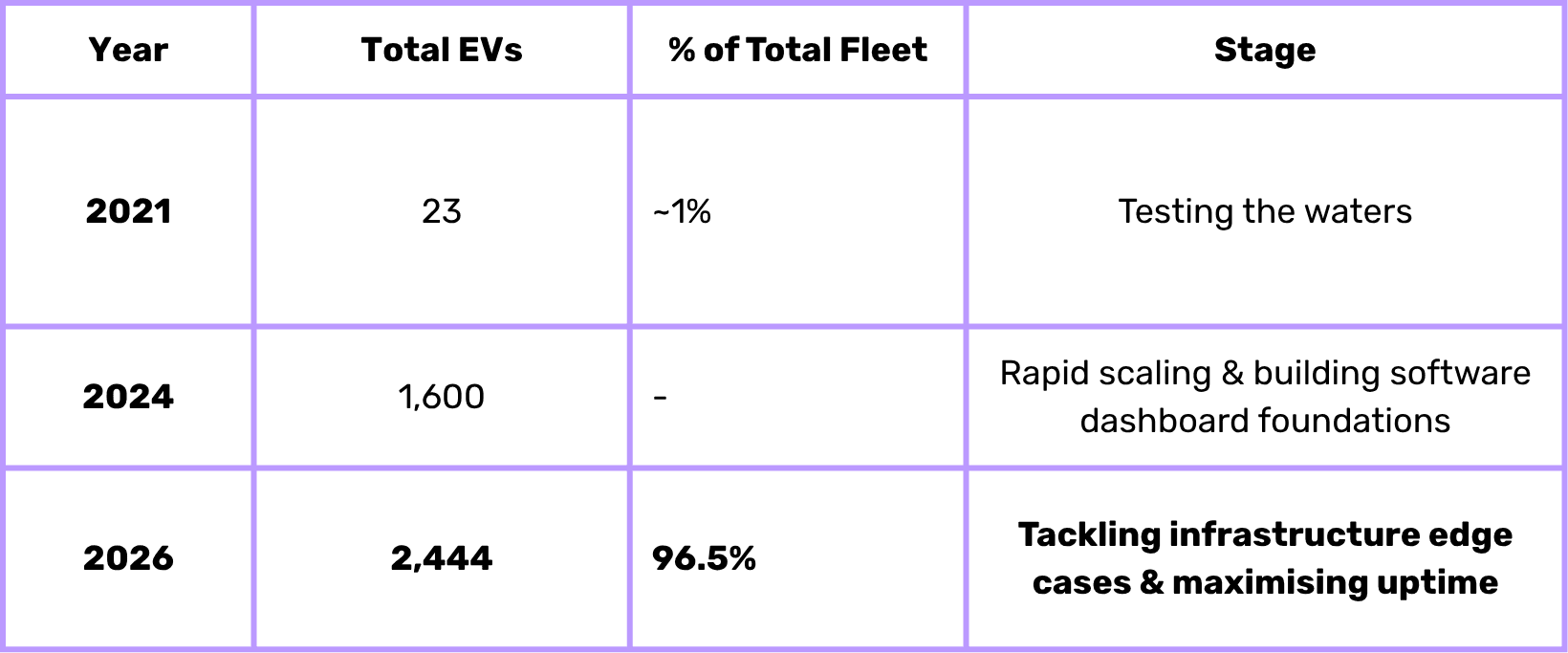
Scaling from 23 to 2,400+ EVs
When OES first started their electrification journey, the commercial EV landscape looked very different.
"Scale is one of our most exciting progressions, but it’s also one of our biggest challenges," noted CEO John Szymik. "While OES grows rapidly, so does the demand for smart meters and environmental tech. We need thousands of green-skilled octo-engineers out on the road."
As the fleet expanded, two distinct hurdles emerged: vehicle range for longer trips and home charging access for drivers living in terraced housing or rental properties without driveways.
By 2026, Head of Fleet Operations Tom Hammond and his team hit a phenomenal 96.5% electrification rate, leaving just 106 internal combustion engine (ICE) vehicles in the entire mix.
"The reason why we're not at 100% yet is purely down to current technology limitations," Tom explains. "The leftover ICE vehicles are logistics trucks delivering heavy payloads like heat pumps and solar panels, or engineers operating in remote areas like the Scottish Highlands, where the public infrastructure isn't quite there yet. But as new OEMs enter the market with better ranges, we’re ready to close the gap."
Simplifying Public Charging on the Road
With over 2,400 electric vans hitting the streets daily, managing public charging could easily become an administrative nightmare of lost receipts and dozens of different charging app accounts. OES utilises Octopus Fleet to streamline the entire public network experience.
Instant Data for Fleet Admins
For fleet managers, transparency is everything. John Szymik highlights two favourite features of the Octopus Fleet platform:
A Friendly UI: "Every important piece of information is displayed right on the dashboard. If I need more detail, it doesn't take much to find it."
Real-Time Reporting: "Unlike similar products, after a driver completes a charging session, the data appears in our reporting function almost immediately. We have up-to-date data exactly when we need it."
The Ultimate Driver Backup: Electroverse + The Payments Card
Our public charging network, Electroverse, gives drivers access to over 1.4 million chargers via a single RFID card and app. Over the last 12 months, major networks like Gridserve have been added to the platform, making coverage better than ever for OES engineers.
But what happens if a driver encounters an obscure, off-grid charger?
"In the rarest of times, if we find an obscure EV charger that doesn't accept the Electroverse app, our engineers can use the Octopus Fleet Payments Card to pay via the Visa payment network," says Tom. "For many drivers, it's just a change of mindset. They get another card, they tap, and they keep moving."

Smarter Charging: Home Reimbursement and Getting Creative
To prevent drivers from spending productive working hours parked at public chargers, OES encourages home charging whenever possible so vehicles can power up while drivers sleep.
Solving the "No Driveway" Dilemma
Not every driver has a driveway. Terraced houses, street parking, and rented accommodations present very real roadblocks to installing home chargers. OES tackles this by embedding flexibility into the working day:
Scheduled public charging windows: Giving drivers dedicated time to access rapid public chargers without rushing.
Infrastructure education: Equipping engineers with deep route knowledge to reduce operational downtime and get them home earlier.
"Weird and Wonderful" Customer Micro-Charging
Innovation is very much a part of OES’ approach. They’ve even introduced a creative way to top up vans while out on customer installations.
"When our customers have EV chargers at their homes, and they are also Octopus Energy customers, we actually plug our vans into the customer's charger while our engineer is on-site working," Tom shares. "Then, we give the customer the money back directly through their energy tariffs. We are always looking at creative ways to charge the vehicle while reducing engineer downtime."
The Verdict: A Blueprint for Next-Gen Fleets
Fleet electrification isn't just about buying electric vans; it’s about deploying the right ecosystem to back them up. By pairing smart vehicle choices with an intuitive management platform, real-time data tracking, and flexible payment options, Octopus Energy Services is paving the way for electric fleets.

Frequently Asked Questions
What is the current size and electrification rate of the Octopus Energy Services (OES) electric van fleet?
2,444 electric vans as of 2026! We are 3.5% away from being fully electric. It’s hopefully not long now - and all the support under Electroverse and Octopus Fleet helps get OES one step closer to a fully electric fleet.
How does Octopus Energy manage public charging for a large electric van fleet?
With the help of Octopus Fleet as a single fleet management platform. From the power of Electroverse helping keep downtime low for drivers on the go, the availability of home charging reimbursement services, and easy spending - it takes the stress away during the EV transition. With real-time data and consolidated billing, Octopus Fleet keeps fleet admin simple for all fleets - from electric to ICE and everything inbetween.
What innovative solutions does OES use to combat range anxiety and reduce driver downtime?
Downtime is always one to keep low for fleets - to increase productivity! With traditional fleet operations, it’s easier to understand and predict the downtime sessions for drivers - due to years and years of practice. However, OES are jumping on new methods to reduce driver downtime and combat range anxiety with electric van charging at home. They are even utilising their time on the job, by charging at customers homes - repaying back the charge through their Octopus account. Killing two birds with one stone - one charge at a time.
What are the biggest challenges faced when transitioning a large commercial fleet to electric vans?
It's time for tech! Many fleet managers are waiting for new top level technology to help meet the fleet needs - in a way that electric fleets at the moment cannot. At OES, for example, the equipment needed for energy services can be very hefty to travel and move around! As weight can impact the range of an EV, this is a concern for specific fleet managers. But do not fear! New technology is growing and big steps are being made in the right direction for the future of fleets.