
Fuel vs. Electric: The Fleet Manager’s Guide to Saving Money in 2026
At a glance, Fuel vs Electric
The New Tipping Point: Thanks to lower public charging costs (averaging 54p/kWh), switching an iconic Ford Transit to an electric E-Transit can save you £120 a month per vehicle using public networks alone.
The Home Charging Jackpot: Pairing a home setup with a smart tariff like Octopus Intelligent Go (8p/kWh) slashes running costs to a tiny £55 a month - saving you up to £437 monthly per vehicle compared to diesel.
Zero-Headache Mixed Fleets: Transitioning at your own pace? Our Visa-backed Fleet Card lets you seamlessly pay for petrol and diesel today while bridging the gap to tomorrow.
One Card, 1.4 Million Chargers: Give drivers one-tap access to the Electroverse public charging network and eliminate manual expenses.
Holistic Cost Control: From managing EV energy tariffs to tracking daily business spend (meals, hotels, tolls) on our dedicated business payments card, keeping your fleet running has never been this simple.
Let’s dive in 👇

If you’re a fleet manager, the recent news that, for the first time in over a year, the UK public charging falls below the cost of petrol, may have got you thinking more about fleet electrification and EV charging vs fuel costs. No matter where you are in your journey, the volatility of fuel prices will make budgeting tricky and not sustainable in the long run.
Brand new data from ChargeUK shows that the public networks are now cheaper per mile than petrol for the first time. But what does this really mean for businesses that are electrifying, and how much can you actually save?
Why electricity is a predictable winner
Managing a diesel/petrol fleet in the current climate creates unpredictability, and recent global disruptions have led to double-digit percentage increases at the pump.
As a fleet manager, it’s becoming impossible to predict what the real costs will be for running a modern fleet, which complicates any forecasting. Rather than asking “when will fuel prices come down?”, you need a strategy that isn’t as susceptible to global events.
In contrast, the electrification of a fleet introduces several layers of cost control that internal combustion engines (ICE) simply can’t match:
Diversified energy sourcing: Unlike fuel, which is tied strictly to global oil reserves, EV fleets can "source" energy from multiple points - ultra-rapid public hubs, slower destination chargers, or home charging.
The off-peak advantage: While public charging has reached price parity with petrol per mile, home charging on specific EV tariffs remains the lowest cost-per-mile available in the UK. This creates a "blended" fuel cost that is significantly lower than a purely petrol-based operation.
Efficiency at scale: The thermal efficiency of an electric motor is roughly 85-90%, whereas a petrol engine loses about 70-80% of its energy to heat and friction. Factually, you are getting more "work" out of every pound spent on energy.
When we compare the cost per mile, the winner is clear. Even with energy fluctuations, charging an EV at home - especially using off-peak tariffs - is a fraction of the cost of filling up at the pump.
According to information from Charge UK, drivers can expect to pay around 15p per mile in comparison to the current rate of 17p for a typical petrol car or 17.5p for diesel.
The "real-world" comparison: Ford Transit vs. E-Transit
To truly understand how this stacks up, we have to look at this in practice. Let’s take the Ford Transit - a staple of British fleets - and compare the traditional diesel model against its electric counterpart, the E-Transit, over a standard 2,000-mile month.
The Baseline (Diesel):
Fuel Price: £1.89 per litre (current UK average, April 2026)
Efficiency: 34.9 MPG
Monthly Fuel Bill: ~£492 per vehicle
The Electric Alternative (E-Transit):
Energy Price (Fast Charging): 62p per kWh
Monthly Charging Bill: ~£427 per vehicle
Our Subscription: £4.50 per driver, per month
Monthly Saving: £60
But if we apply the 54p per kWh average recently shared by ChargeUK for public charging, the figures become even more compelling:
Our Subscription: £4.50 per driver, per month
Total Monthly Bill (charging and subs): ~£376.50 per vehicle
The Monthly Saving: ~£115.50 per vehicle
Layering in EV home charging reimbursement
So, public charging is now cheaper than petrol, but home charging remains the true hero for fleet efficiency. Let’s imagine you have a fleet of 100 E-Transits, and 10% of your drivers can charge their work vehicles at home.
Here is how the math looks when you mix in the Octopus Intelligent Go 8p tariff for those 10 vehicles:
Monthly Cost Comparison (per vehicle, 2,000 miles):
Diesel Transit: ~£492
E-Transit (Public Average 54p + £4.50 driver monthly driver subscription): ~£376.50
E-Transit (Intelligent Go 8p + £9.50 monthly drvier subscription): ~£64.50
By moving just one driver from the public network to an Intelligent Go home setup, you are saving an additional £312 per month for that single vehicle compared to the public average - and an impressive £427 per month compared to diesel.
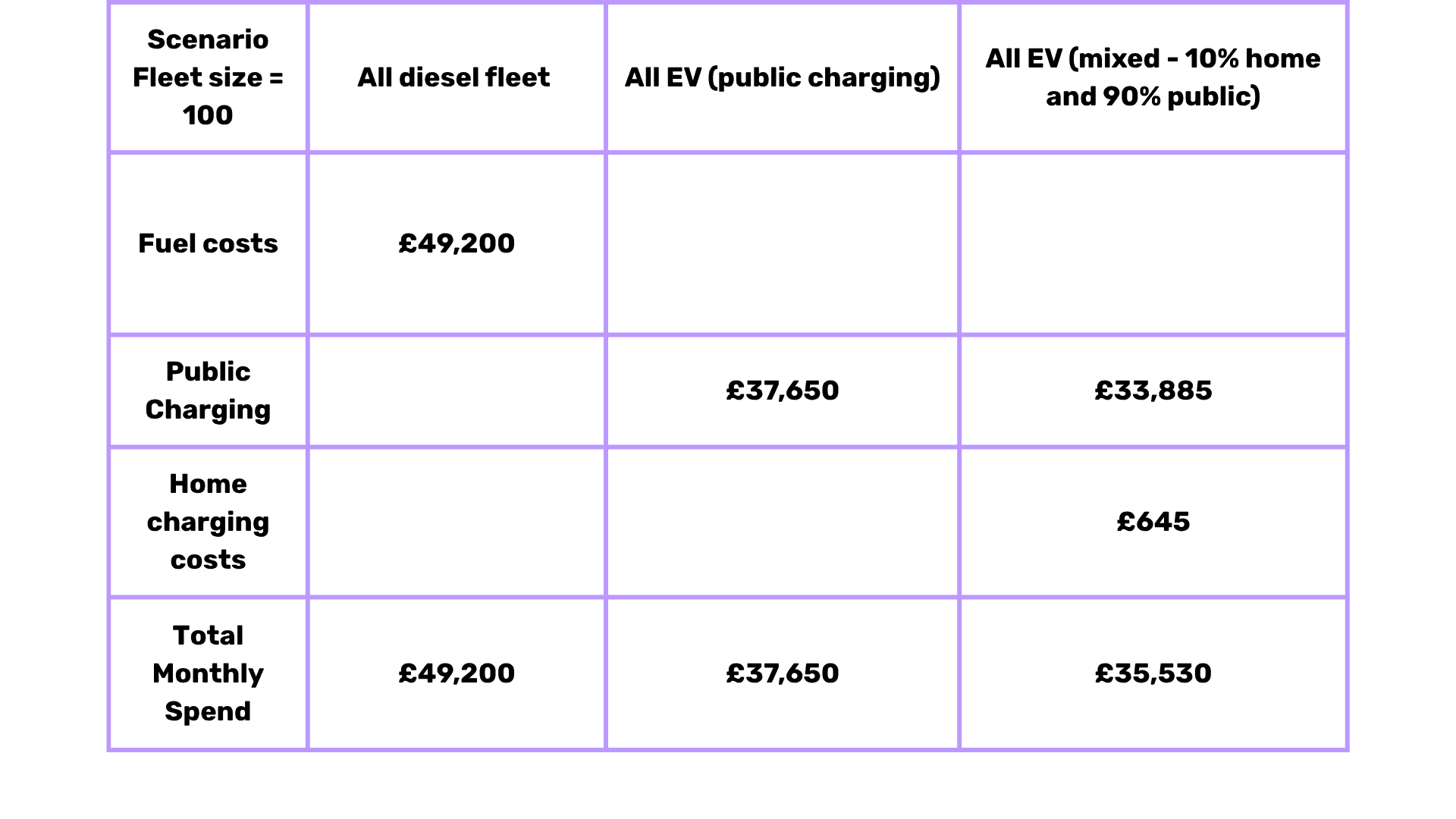
To keep things as transparent as possible, here is the math behind these figures:
Vehicle Models: Comparison based on a standard Diesel Ford Transit vs. an Electric Ford E-Transit.
Efficiency: Diesel efficiency assumed at 34.9 MPG; EV efficiency assumed at 2.8 miles per kWh (Fast charging).
Fuel Pricing: Diesel cost at the UK average (RAC) of £1.89 per litre.
Charging Rates: Public charging based on ChargeUK’s 54p/kWh average. Home charging based on the Octopus Intelligent Go off-peak rate of 8p/kWh.
Usage: Calculations based on an average monthly distance of 2,000 miles per vehicle.
Subscriptions Factor: Public EV figures include our £4.50/month fee. Home EV figures include our £9.50/month reimbursement software fee.
Note: Real-world results will vary based on driving style, payload weight, and ambient temperature.
A quick reality check on home rates: > We’ve used the 8p/kWh Octopus Intelligent Go rate here because it represents the gold standard for EV efficiency. However, we know not every driver’s home is set up for this yet. Even if your team is on a standard variable tariff (approx. 24.5p/kWh), they are still running at roughly half the cost of diesel. The 8p rate isn’t just a nice-to-have; it’s the massive additional saving we can help you unlock as your fleet matures.
How much can a fleet save over a year in comparison to fuel?
When you start looking at the annual operating budget, there’s opportunity for a huge impact on your bottomline.
Based on our scenario of 2,000 miles per month, that business is spending nearly £600,000 a year just to keep those ICE vehicles moving.
By transitioning to an electric fleet - even one that relies predominantly on the public charging network - that same business can expect to save ~£138,600 per year. If you go even further and enable even a small portion of your team to charge at home via a smart tariff like Intelligent Go, that saving climbs toward ~£164,000.
You then can look at other more ways to optimise your future fleet operations - those savings can be reinvested into depot charging or home charger installations for your team members.
For fleet managers, the question isn’t "Will this save us money?" but "How quickly can we implement a system that captures these savings?" At Octopus Fleet, we’re here to make that transition refreshingly simple - from the first mile to the millionth.
Ready to future-proof your fleet?

Frequently asked questions
Is public EV charging actually cheaper than petrol in the UK?
Yes. As of early 2026, the market has reached a significant tipping point. Independent data from ChargeUK shows that the average cost of public charging (approx. 54p per kWh) now makes electric vans cheaper to run per mile than their diesel counterparts. While petrol and diesel prices remain tied to volatile global oil markets, EV charging offers a more stable, and now more affordable, alternative for high-mileage fleets.
How do I reimburse drivers for charging electric fleet vehicles at home?
Reimbursing drivers for home charging used to be an administrative headache, but it’s now refreshingly simple. Using automated Home Reimbursement software, you can track exactly how much energy a driver uses for business miles. Systems like ours integrate directly with smart tariffs, such as Octopus Intelligent Go, ensuring the driver is paid back accurately at their specific rate (e.g., 8p per kWh), with no manual receipt chasing required.
Can my fleet handle long-distance routes with current UK charging infrastructure?
Absolutely. With over 1.4 million chargers accessible through the Electroverse network, "range anxiety" is a thing of the past. For fleets running long-distance routes, the UK’s network of ultra-rapid chargers ensures minimal downtime, while one-card payment solutions mean your drivers spend less time at the plug and more time on the move. Learn more about our fleet public charging solution.
What is the Benefit-in-Kind (BIK) rate for electric company cars in 2026?
For the 2026/27 tax year, the BIK rate for zero-emission vehicles remains at 3%. This is a massive incentive compared to internal combustion engines (ICE), which can see rates as high as 37%. For fleet managers, this makes EVs an incredible tool for both reducing company tax liability and improving employee recruitment and retention.